The construction of one of the most complicated parts of the HS2 project took a step forward over the Christmas break, as Balfour Beatty VINCI completed two key viaduct spans over the existing railway near Water Orton in Warwickshire.
The spans form a small part of the Delta junction – a huge triangular intersection being built to the east of Birmingham for the new high-speed railway.
Like the nearby Spaghetti Junction, it is formed of a complex series of interconnected viaducts, taking the high-speed line over motorways, local roads, existing railways, rivers and floodplains. It is designed to carry HS2 services to and from Birmingham, as well as connecting to the mainline heading north and south.
To maintain speeds of 360km/h on the mainline and around 200km/h on the approaches to Birmingham, the junction is stretched out over a far larger area than a motorway junction, with 2.6 miles of track, including underpasses, flyovers and five major viaducts.
The Water Orton viaducts are at the northern end of the junction and will allow southbound trains to join the spur into Birmingham Curzon Street and the rolling stock depot at Washwood Heath.
Engineers working for Balfour Beatty VINCI used a five-day closure over the quieter Christmas period to safely complete the two parallel spans over the existing Birmingham to Peterborough railway line.
With the railway crossing complete, the team can move on to the next sections of the viaducts over the nearby A446 road and the M42 motorway next year.
Stephane Ciccolini, Senior Works Manager at Balfour Beatty VINCI, said: “This complex section of the HS2 route has taken a major step forward, after Balfour Beatty VINCI teams successfully erected two viaducts spans over an existing railway near Water Orton.
“We’ve worked around the clock during the Christmas period to deliver this incredible feat of engineering, using a specialist cantilever technique not seen in the UK before this project. This approach involves using a 22-metre-high mast and a 14-metre-high swivel crane to move each individual segment into place until the span is complete.”
Sam Hinkley, HS2 Ltd’s Senior Project Manager said: “It’s great to see the Water Orton viaducts in place across the railway and I’d like to thank everyone who gave up their Christmas to help us reach this important milestone and I’d like to thank passengers for their patience.
“These precast segmental viaducts form a key part of the Delta junction – one of the most complex parts of the HS2 project and I look forward to seeing more progress in the year ahead.”
Once complete, the two single-track Water Orton viaducts will stretch for around 1.4km across two railways, a river, local roads and the M42.
The viaducts are made of pre-cast concrete segments that are installed using a huge cantilever process. Once each span is in place, the permanent post-tensioned cables are installed in the hollow centre of the viaduct allowing the temporary cables stays to be moved forward to support the assembly of the next span.
The same process is repeated between each pier until all the spans are complete. The 32 concrete piers that support the Water Orton viaducts are up to 20m tall and cast in situ using bespoke formwork and reinforcing cages manufactured at nearby Coleshill.
The Water Orton viaducts form part of 3.7 miles worth of viaduct across Delta junction which are being built using this approach. All 2,742 concrete segments needed for the viaducts are being manufactured at a temporary factory at nearby Lea Marston.
ENDS
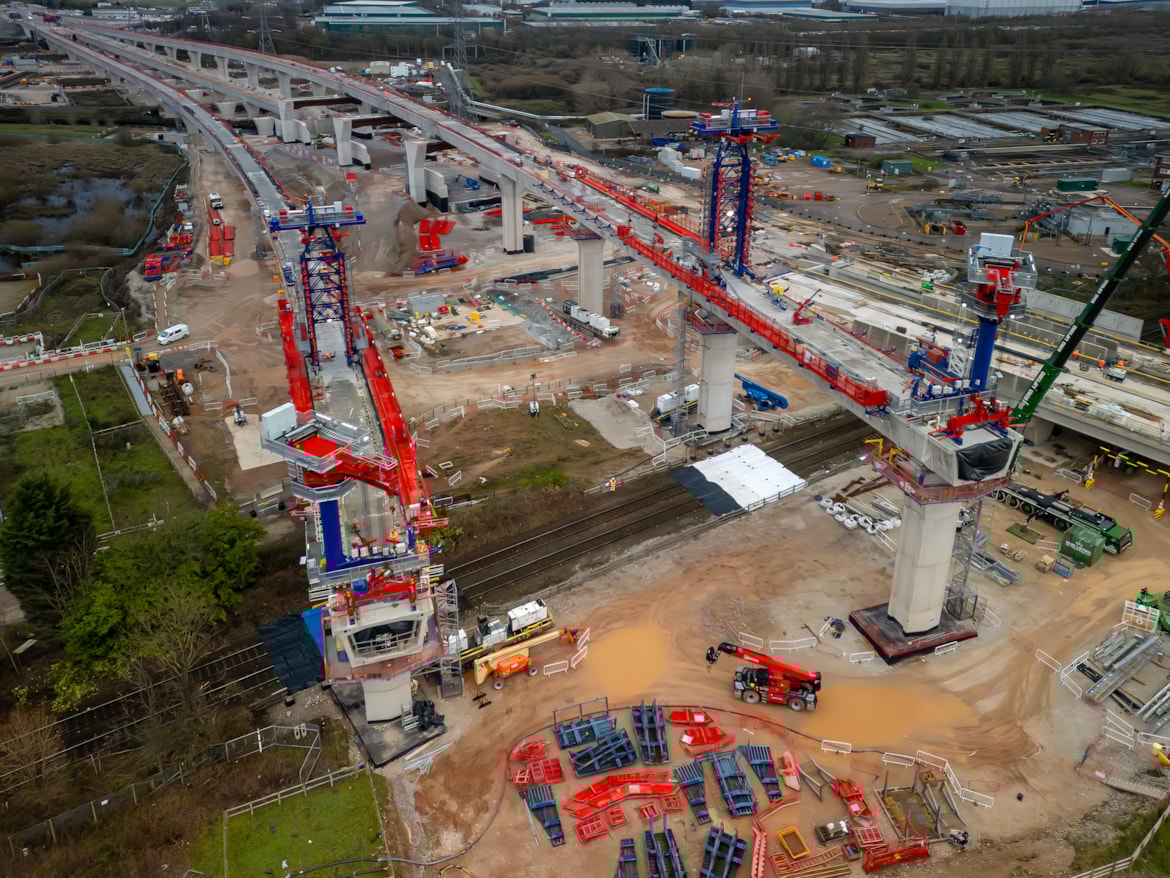
HS2 viaducts
