Why protecting communities means thinking beyond flood defences
Across the UK, communities are facing a growing challenge. Climate pressures are increasing, demand for new housing and infrastructure continues to rise and the places we depend on are becoming more connected than ever before.
Traditionally, flood risk has been addressed through individual defence schemes. But creating resilient places requires a broader perspective.
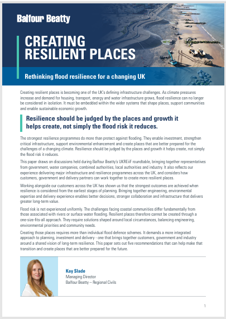
Our latest insights paper – Creating Resilient Places: Rethinking flood resilience for a changing UK – explores why flood resilience should no longer be considered in isolation and how it can be embedded into the wider systems that support communities, infrastructure and economic growth.
Resilience is about more than preventing floods
The strongest resilience programmes do more than protect against flooding. They create confidence for investment, strengthen critical infrastructure, support environmental improvement and help communities thrive despite the challenges of a changing climate.
As the paper argues, resilience should be judged by the places and growth it helps create, not simply by the flood risk it reduces.
Drawing on discussions from our UKREiiF roundtable and our experience delivering resilience programmes across the UK, the paper sets out how customers, government and industry can work together to create places that are better prepared for the future.
Five recommendations for creating resilient places
The paper identifies five priorities for the future of flood resilience:
Flood risk does not follow administrative boundaries. Planning around catchments, coastlines and communities creates better long-term outcomes.
Housing, transport, energy and economic development all depend on resilient infrastructure. Resilience should be considered from the earliest stages of planning.
The most effective programmes combine engineering, nature-based solutions and place-based interventions to create infrastructure that can adapt over time.
Better information, predictive modelling and long-term thinking can help target investment where it creates the greatest value.
Long-term resilience depends on skilled people, strong partnerships, confident supply chains and a visible pipeline of investment.
Read our insights paper
Creating resilient places requires a shift in thinking. It means moving beyond individual flood defence schemes and taking a more integrated approach to planning, investment and delivery.
Read Creating Resilient Places: Rethinking flood resilience for a changing UK to explore the challenges, opportunities and recommendations shaping the future of resilience across the UK.